
The reconstruction of the mausoleum of Vervicius and Vervicia as it stands today was carried out in 1984 by Louis Lefèbvre, former curator of the Musée d'Arlon. By analysing the blocks, he found that six of them could be placed in the same monument, based on their material, geometry and common place of discovery. He found that the four blocks with scenes were arranged in a square, supported at the front by two pillars and at the back by another building. Similarly, a large square slab with a bevelled edge was discovered during the excavations. This may have formed at least part of the roof of the mausoleum.
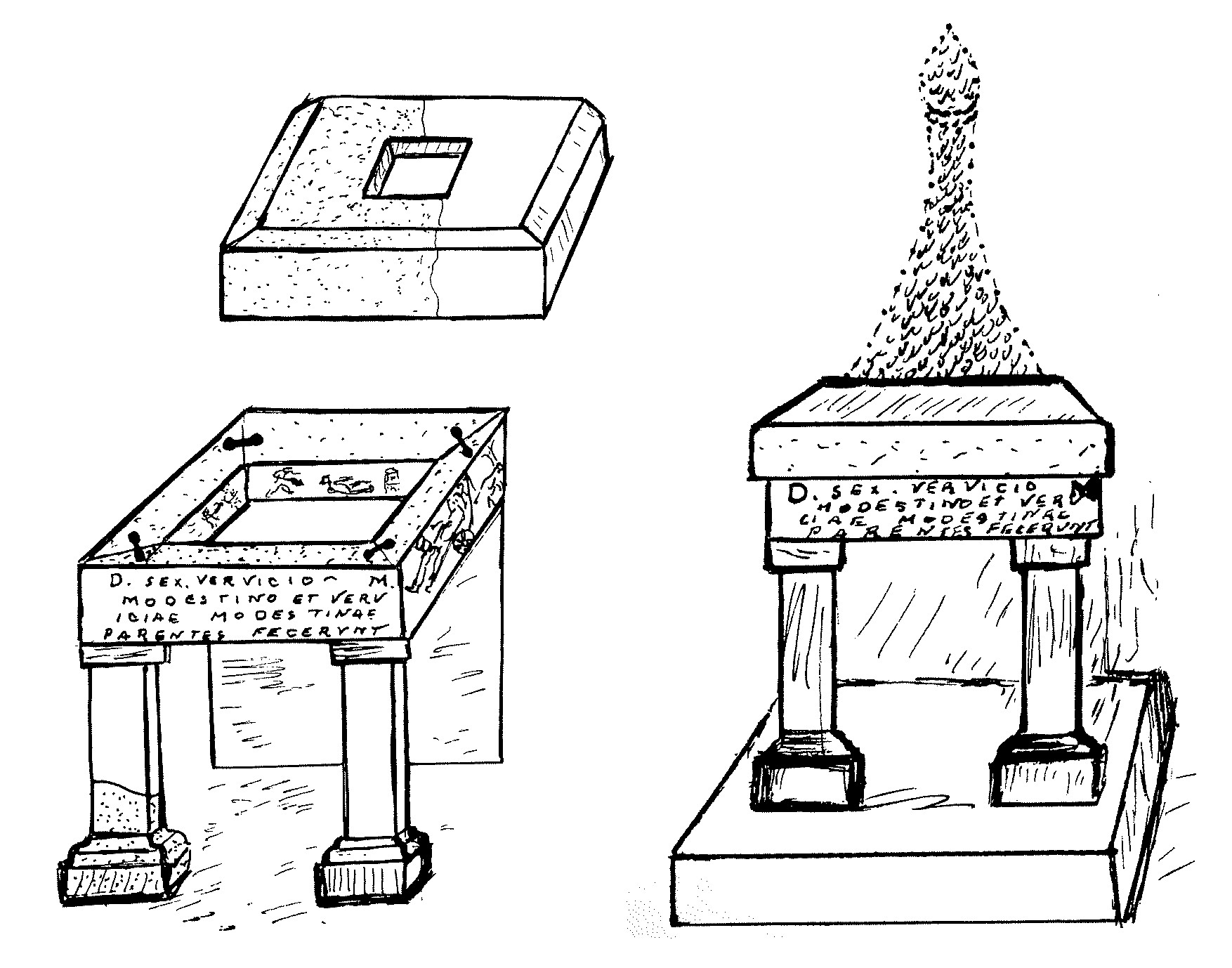
Drawings of the reconstruction proposed by Louis Lefèbvre (from L. Lefèbvre, 1981)
On top of this cornice, however, he freely placed the reconstruction of a pyramid dominated by a pine cone. As for the base of the monument, it would have rested on a pedestal, but this has not been reconstructed in the museum due to lack of space. The original stones, however, are still clearly visible and stand in stark contrast to the reconstructed elements.
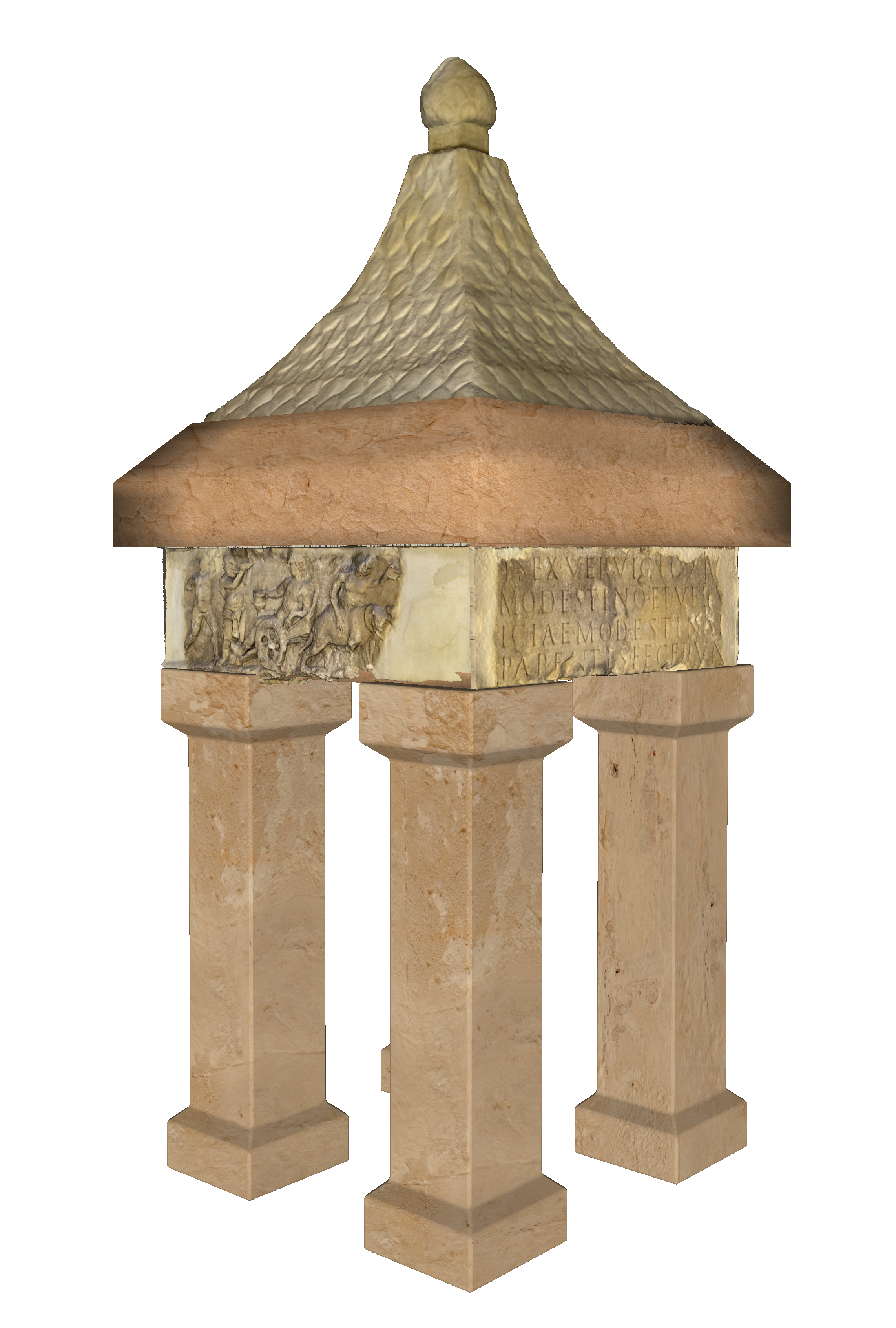
Reconstruction of the mausoleum in 1984
The reconstruction still on display in the museum is therefore only partial. It was inevitably subject to the constraints of the space available, which necessitated certain adjustments. This is particularly true of the pedestal, which was generally quite high and was intended to support the tomb. In addition, four pillars were placed to support the blocks, although the study tends to show that only the two in front are probable, while the rear part rested on a low wall leaning against another building.
