

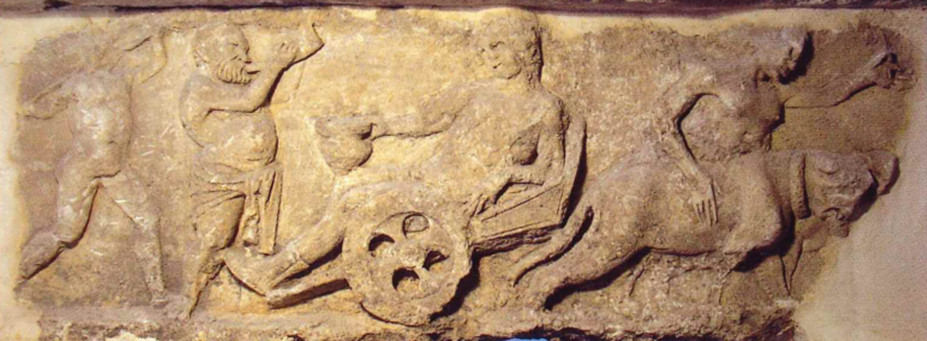
This external relief, on the left side of the monument, depicts the triumph of Dionysus (Bacchus for the Romans) on his return from the Indian campaign. In this episode, Dionysus has to prove himself against the other gods. With the help of his satyrs and maenads, he sets off to conquer faraway India. There he faced many enemies, some of whom he won over by introducing them to wine. The procession of Dionysus and the triumph of the Indians were very popular in ancient times. The scene was therefore depicted many times. Over time, representations of this god became increasingly common in funerary contexts. People turned to him and his thiasus (the retinue of a deity, especially Bacchus) to ask for protection for the dead.
A closer look at our relief shows Dionysus in the centre, reclining on a two-wheeled chariot, accompanied by his retinue. The god of wine is depicted with a youthful, beardless face and curly hair, illustrating his eternal youth. He holds a canthara in his right hand and his left arm rests on the edge of the chariot, holding a thyrsus (sceptre). The same chariot is drawn by two panthers, the god's fetish animal, led by a maenad*. At the rear of the chariot is Silenus, with a shaggy beard, blowing a horn and wearing a garment tied at the bottom of his belly. He is followed by a satyr, also holding a thyrsus.
*Satyrs: mythological creatures generally associated with Dionysus. They are half human and half animal, with the ears, tails and feet of goats.
*Maenads (or Bacchae in Roman): Companions of Bacchus, but the word also refers to the women who celebrate the festivals in honour of the god.
*Silenus: believed to be the adoptive father of Dionysus, who was entrusted with the education of the young Dionysus. He is often depicted as a jolly old man, not always very handsome.
