

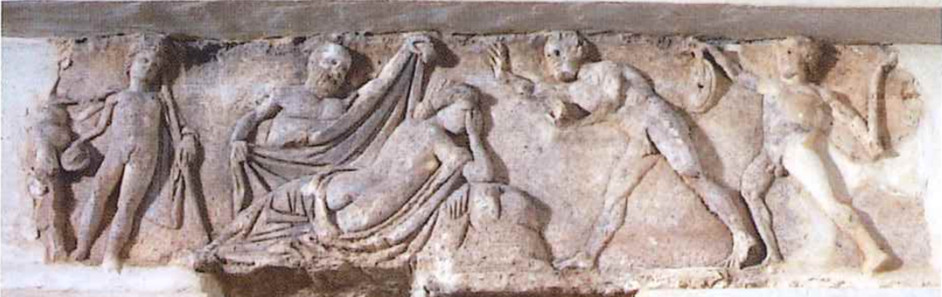
On the outside right of the mausoleum, we can see the discovery of Ariadne in Naxos by Dionysus (or Bacchus, for the Romans), accompanied by his famous procession (the thiasus), made up of satyrs* and maenads*. In Greek mythology, the Cretan princess Ariadne was seduced by the Athenian hero Theseus, helping him to escape from Daedalus' Labyrinth. However, after his victory over the Minotaur*, Theseus abandoned her on the island of Naxos. By chance, Dionysus stopped off on the island of Naxos and discovered Ariadne. He later married her.
In the centre of the composition, Ariadne is shown half-reclining on a rock, wearing a drapery open at the back, probably weeping after being abandoned. To her left, the paunchy Silenus*, depicted as a bearded old man, uncovers her hidden under a cloth. Behind him, Dionysus, recognisable by his curly hair, is wearing a chlamydia (a short cloak grafted to his shoulder). In his right hand, he is holding a canthara (the wine cup typical of ancient Greece) and in his left, a thyrse (sceptre), his main attribute. A satyr (?) is at his side, while two other satyrs are to Ariadne's left, one quite agitated and the other holding bronze cymbals and a rod.
*Satyrs: mythological creatures generally associated with Dionysus. They are half human and half animal, with the ears, tails and feet of goats.
*Maenads (or Bacchae in Roman): Companions of Bacchus, but the word also refers to the women who celebrate the festivals in honour of the god.
*Minotaur: Mythological monster with the body of a man and the head of a bull.
*Silenus: believed to be the adoptive father of Dionysus, who was entrusted with the education of the young Dionysus. He is often depicted as a jolly old man, not always very handsome.
