

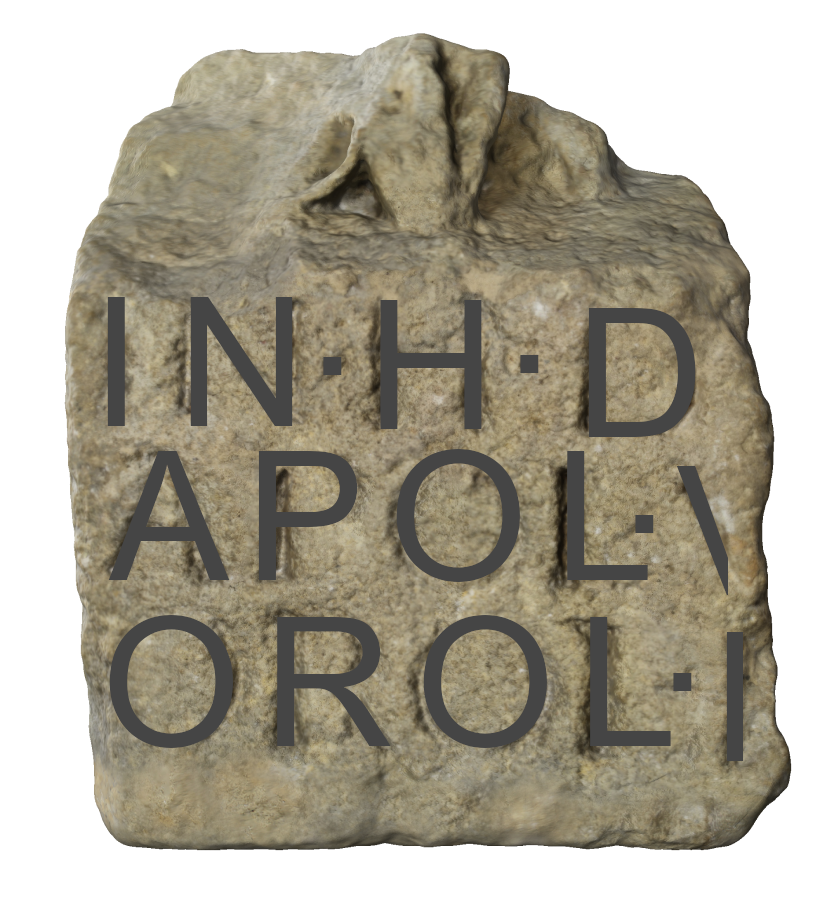
The importance of this stone lies in its Latin inscription, which is partially damaged. It can still be read today:
I N · H · D
A P O L · \
O R O L · |
Like most Latin inscriptions, ours contains several abbreviations. The first line, for example, is: IN H(onorem) IN H(onorem) D(omus) D(iuinae). This translates as: 'In honour of the divine house', meaning the imperial house. It was common for the emperor and his family (even his ancestors) to be associated with the god in the same dedication. In several inscriptions, a third D follows the previous two to indicate the divinity D(eo). This might make sense in the second line.
It begins with Apollo: APOL(lini), probably followed by a V, of which only a sidebar remains today. This word is important because it refers to the status of the city of Arlon in Gallo-Roman times, in this case as a vicus (small settlement). This is the only epigraphic record that contains this information for Arlon.
The last line refers to the name of the town: OROL(aunenses) - 'de Arlon'. A partially destroyed letter with a vertical bar remains. It is probably a P from the word P(osuerunt): 'erected'.
The inscription therefore reads: 'In honour of the divine (imperial) house, to Apollo, the inhabitants of the vicus of Arlon have erected (this monument)'.
